My favorite cowgirl and I headed down to our pasture ground last Sunday to search for grass. Nebraska has been moisture deficient since early last summer and, in particular, the drought has greatly hurt the 23 millions acres of grass pasture that makes up more than half of Nebraska’s land mass.
While the vast majority of our land is crop ground, we do have approximately 600 acres of cool season grass pasture in the Platte River Valley. Typically, we graze cattle on this land from April to Mid-June, and then again from August to October. I purchase “light yearlings” or “fall calves” that weigh 600-650# to graze on this land.
We grow these animals on grass pasture until they weigh approximately 800#. At that time (or at the time that all of the grass is eaten), we bring them into the feed yard to prepare them for harvest.
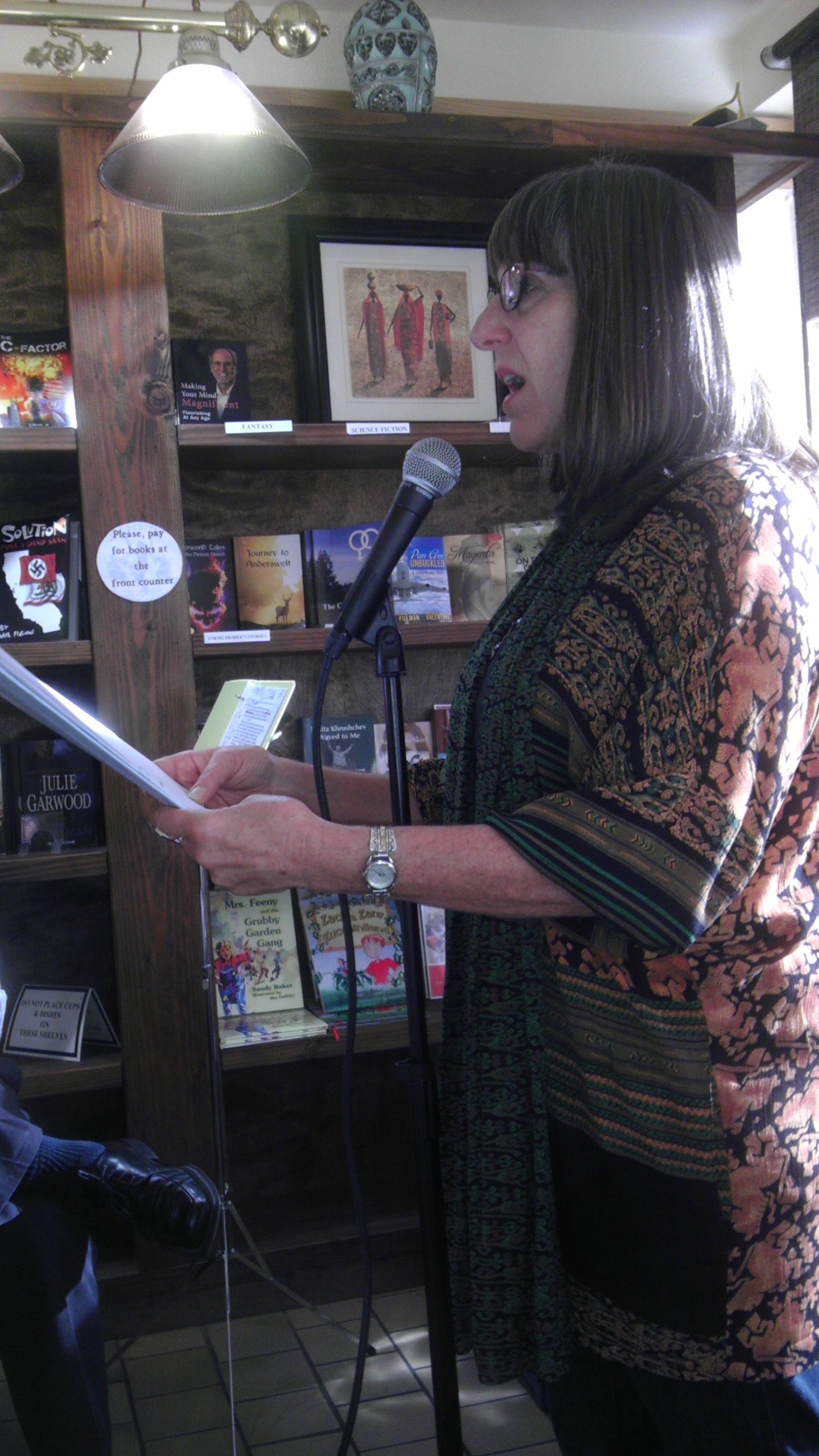
Redwood Writers member Michelle Wing entertained us as a Featured Reader for the RW Open Mic yesterday at SoCo Coffee in Santa Rosa. Her poetry enticed us to picture the images and appreciate the rhythms and moods of her work as we celebrate April as National Poetry Month. Thank you, Michelle!
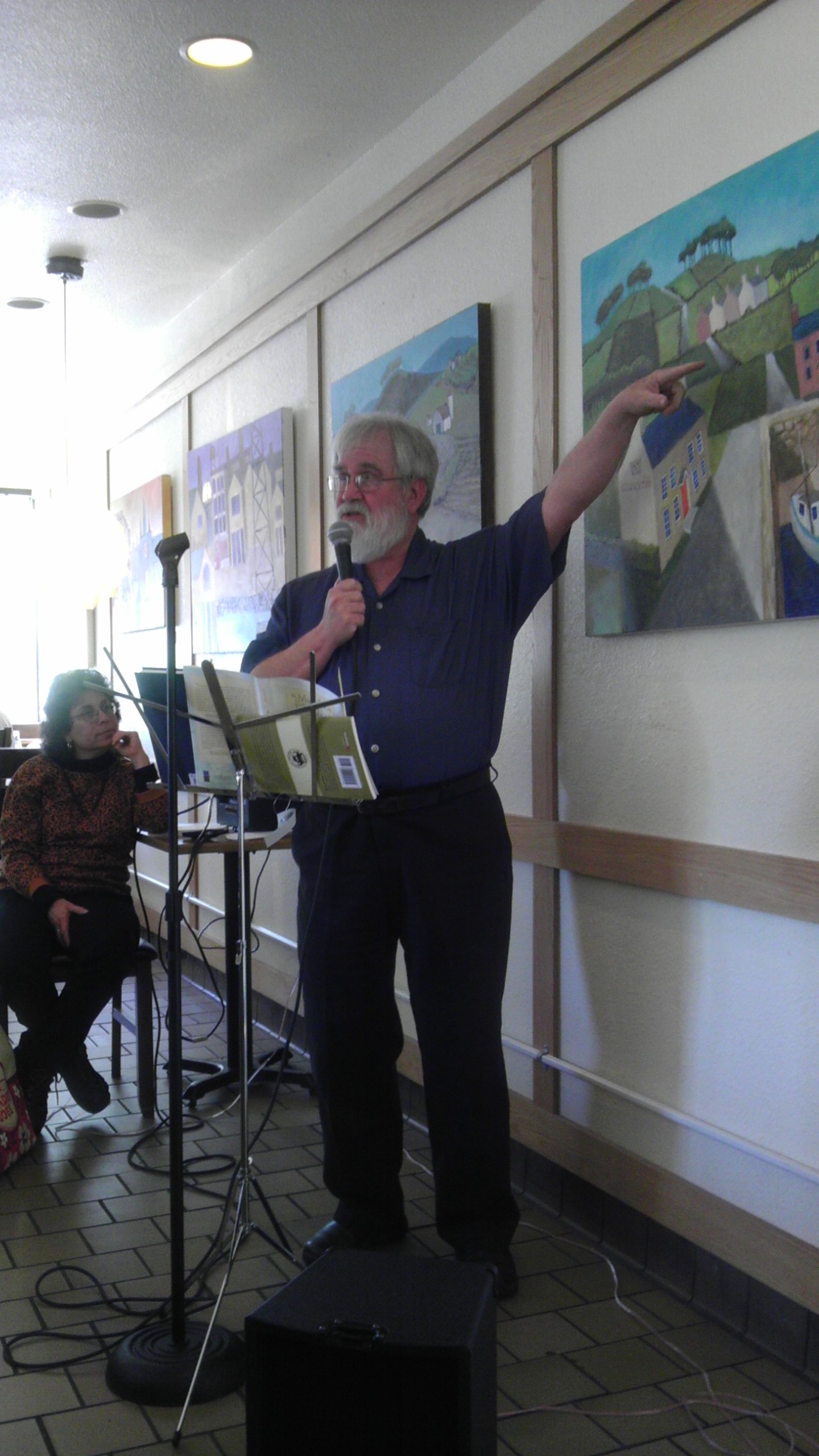
Gil Mansergh, a past president of Redwood Writers, was one of our two Featured Readers on Saturday, April 27, at the RW Open Mic at SoCo Coffee. Here he utilized the painting behind him to help us visualize the town of Gloucester, MA, setting of his novel THE MARVELOUS JOURNALS OF MISS VIRGINIA PETTINGILL. You may enjoy Gil’s literary radio show on the 1st Wed. of each month at 7 pm on KRCB.
Share YOUR Literary Treat at the Redwood Writers
Open Mic Readings
at SoCo Coffee on
Sat., April 27th 2 to 4 p.m.
Featured readers: Michelle Wing and Gil Mansergh
Join us for camaraderie and coffee or tea. Light snacks are available. Please support the SoCo Coffee venue with a purchase.
Open mic sign-ups start at 1:30 p.m. First come, first serve. Open Mic limited to five min. per person. Bring a friend!
Abby Bogomolny will be the M.C.
Contact: Abby Bogomolny at ever3009@gmail.com
or Robin Moore, rockridge6532@comcast.nethttps://robinofrockridge.wordpress.com/
For details visit our website: http://redwoodwriters.org/
(*Easy driving directions from 101 freeway to SoCo Coffee: Take College Ave., going east. Go straight through intersection with Brookwood Ave. Go one (short) block and turn right on Chinn St. Go 2 blocks, SoCo will be on your right. Off street parking is available. There’s plenty of parking on Chinn St.) 1015 4th St., corner of Brookwood Dr.
Redwood Writers
Open Mic Readings
at SoCo Coffee on
Sat., April 27th 2 to 4 p.m.
Featured readers: Michelle Wing and Gil Mansergh
Join us for camaraderie and coffee or tea. Light snacks are available. Please support the SoCo Coffee venue with a purchase.
Open mic sign-ups start at 1:30 p.m. First come, first serve. Open Mic limited to five min. per person. Bring a friend.
Abby Bogomolny will be the M.C.
Contact: Abby Bogomolny at ever3009@gmail.com
or Robin Moore, rockridge6532@comcast.nethttps://robinofrockridge.wordpress.com/
For details visit our website: http://redwoodwriters.org/
(*Easy driving directions from 101 freeway to SoCo Coffee: Take College Ave., going east. Go straight through intersection with Brookwood Ave. Go one (short) block and turn right on Chinn St. Go 2 blocks, SoCo will be on your right. Off street parking is available. There’s plenty of parking on Chinn St.) 1015 4th St., corner of Brookwood Dr.
Here’s a “borrowed” blog from dog lover Deborah Taylor-French. She loves to get Sydney to ham it up for the camera! Syd is one amiable guy.
Thanks for sharing, Deborah!
Thank you to my writer friend Linda McCabe for allowing me to post her blog on reading your writing in public. Linda lists eight excellent tips on getting the most out of your public readings. http://lcmccabe.blogspot.com/2013/02/dos-and-donts-of-public-speaking.html Dos and Don’ts of Public Speaking
This blog post is intended for writers who are given the opportunity to read portions of their work aloud. However, others who have to speak in front of an audience may also find some of the suggestions to be helpful.
I have over thirty years public speaking experience. In high school I was a member of our championship forensics team and was an award winning competitive public speaker in the Serious Interpretation category. This advice is the product of my experience as well as my frustration when I have witnessed public readings I have found to be embarrassing.
1. Do know your time limits and plan for them. If you have a short time frame to work with, say five minutes, select a passage that fits within those parameters including any prefatory comments you need to make to set up the scene for the audience. Time yourself. If it goes long, consider choosing another passage or perhaps change your beginning or ending places so that it fits in the time frame.
2. Don’t Ramble or waste time. I have been to a few open microphone sessions where a writer is one of several speakers, but once they have the mic it seems as if s/he will not relinquish it without a big hook coming out and taking him/her off the stage. I particularly hate it when people ramble, because it demonstrates they were not prepared.
If you are given five minutes to speak, that five minutes starts from the time you are given the floor or handed the microphone. Rambling for four minutes before you start reading does not mean you still get to read for an additional five minutes. Nope. If you are given five minutes, you have five minutes. Especially if you are sharing a stage with others. That means that there will be members of the audience who came specifically to hear someone else speak. If you go over your time limit, (by more than a minute or two), you will be cutting into others’ time or causing the program to go long.
Recently I saw an author bring her book to the stage, but her opening was not a statement used to set up her reading. Instead she rambled on and on about her life. She spent her entire time speaking without any discernable purpose, used up her entire time and never read a single word from her book. It became nothing more than a prop she waved in the air.
A different example of wasting time was when I delivered an academic paper at an international conference. I was one of three speakers in a session and I was given the last speaking slot. We were all to have an equal twenty minutes to present. However, the first speaker was a college professor who had not timed his presentation until the night before. He became irritated about the brevity and felt this time constraint caused him to eviscerate the heart and soul out of his talk. He complained about this. Repeatedly. Not just to the panel moderator in private, but during his talk.
He took time during his speech to complain that he did not have enough time. He probably spent a total of three minutes during his talk saying, “oh I cannot go into more detail about that because I do not have enough time.”
He also ignored the moderator when she told him that his time was over, and continued speaking for a few more minutes. This cut into the time left for my presentation. I was professional about it and was able to condense and speed up some of my presentation so the session did not run overtime.
3. Do make a script that is easy to read. One of my pet peeves is authors reading from their physical books. I think it is fine to read directly from a book if it is a picture book where the pages are read and shown to an adoring crowd of children. Otherwise, it is often awkward for someone to read directly from a bound book. Not only do you have to fight with the binding, losing your place if it closes, but the font is generally not large enough to read with ease.
If you are reading your own story, then make a script off of documents you have on your hard drive.
Boost the font. Make it 18 or 20 point. Make it bold. Whatever works best for you to read without difficulty.
Print it out, and make it so that your paragraphs do not have widows or orphans. It is best to read to the end of a paragraph and then turn the page. Number your pages.
My personal preference is to put the printed pages onto construction paper. This makes it a script where the pages can be changed with ease. I find this easier to use than plain paper with a staple on the top. I also find myself being distracted from the reading by concentrating at the stapled copy in a reader’s hand to assess how many more pages they are going to read. A script with separate pages will remove that distraction.
4. Don’t think that reading glasses will make reading from a physical book easy to do in public.
It will not. Wearing reading glasses while trying to read from a physical book will make you have to look down more often. This will hurt your performance. As your head is turned downward, your voice will be focused downward. Or your throat will be at an acute angle and this will change the tone of your voice and your ability to project your words. Alternately, you could hold the book upward so that your neck is straight and your voice is projected well. This will also cause the book to cover your face making it hard for your audience to see your facial expressions or to have any eye contact with them.
5. Do entertain your audience. Express yourself in a manner that will captivate your audience’s attention. If you are reading passages with dialogue, create different voices to help them understand and follow who is speaking. Use eye contact to engage the audience with you. Having rehearsed your talk enough times and having an easy to read script will allow you to look up and at your audience.
Remember, if you are sharing the stage with others then many in the audience will be there in support of other speakers. They may know nothing about you. Make them sit up and take notice of your performance. Make them feel as if they discovered someone new to admire.
6. Don’t bore your audience. Rambling at the beginning of your talk is lethal for grabbing and maintaining an audience’s attention. Once lost it is hard to get back.
Fumbling with a book and reading glasses as well as speaking in a monotone is also high risk behavior for losing your audience.
Whether you realize it or not, you are competing for all of the audience members’ attentions. Make it worth their while to pay attention to you and not make a mental list of errands that need running or check their email on their iPhone. They could be other places right now, but they are chose to spend a portion of their lives at whatever venue you are speaking. They could change their mind at any moment and leave to go to the bathroom or go home.
7. Do your best to be heard. It is frustrating when a speaker does not project his or her voice well enough to be heard or does not know how to properly use a microphone. If someone objects when you start speaking and says, “I can’t hear you!” make sure that the situation is resolved before you continue with your planned talk. This may mean readjusting the microphone to being closer to your mouth or forcing yourself to SPEAK UP!
8. Don’t think you do not need amplification. I have seen speakers at a podium decide they did not want to use the microphone that is provided. Even after someone in the audience complained. Most of the time speakers are mistaken when they think their voice is loud enough without amplification to be heard in all corners of the room. I only knew one woman who could pull that off with ease, because She Could Project. Loudly. When she chose to project her voice, it was as if she used a megaphone. She was the proverbial exception that proves the rule.
I remember a sad case of a female politician who had become feeble in her old age. She was a guest speaker at an event and when it came time for her to speak, she could not make herself heard by using the microphone. It had worked fine for all the speakers before her, but it seemed as if it stopped working when she took the stage. People scrambled to find a replacement microphone, they tested it and then handed it to her. We were all hopeful this would resolve the problem. She took the microphone and then it became clear that her anemic vocal performance was not due to technology, but due to her inability to perform anymore.
This was heartbreaking for me, because I had looked forward to hearing her talk and knew she had a wealth of knowledge and a lifetime of experience that was worthy of hearing. I stopped straining to make out her words, and instead accepted that I could not hear her unless I was standing next to her onstage.
—
Here is an example of a recent public speaking appearance where I read a passage from my novel. You can see how I used a script, varied my voice to entertain the audience, tried to use eye contact and did my best to be heard over the ambient conversation of those in the restaurant who were not there for the literary event.
I was the only participant to stay in the 5-7 minute time frame mentioned at the beginning of the event.
Judy Baker, brand evangelist and Certified Action Plan Marketing Coach, will teach you how to consistently attract qualified clients with sustainable marketing systems that grow your business.Is your networking failing to produce the results you desire? Is your desk buried in business cards you meant to put into your database, but didn’t? Are there thank you notes that you meant to write and mail out sitting blank? Were you intending to make a call, send out information, or set an appointment? Are your social media profiles stale, confusing or missing in action? Feeling guilty, overwhelmed, confused, or anxious? Baker will show you how to turn those business cards into contacts, connections and clients.
Judy Baker uses engaging stories to build brands. In 2012, Baker transformed her own brand, Completely Creative, into brandvines. President of the Bay Area Independent Publishers Association since 2011, and on the Board of the Bay Area Consultants Group, Baker brings leadership, graphic design, public speaking and collaboration skills to these groups and to her clients. She specializes in working with authors, speakers and health care providers. One of her websites.
Come read your poetry or prose (or nonfiction!) aloud at the next Open Mic hosted by the Redwood Writers branch of the California Writers Club, on Saturday, February 23rd from 2-4 p.m. at SoCo Coffee in Santa Rosa. Sign in time starts at 1:30 p.m. MC for the day will be Abby Bogomolny.
Readings are limited to five minutesper person–that includes any introduction you may wish to make for your work.
The last three months we’ve had approximately 30 people attend, so there may be another good sized audience eager to hear your writing. (Please note, attendance may vary.)
These Open Mics are open to ANYONE. They are not limited to Redwood Writers members. We look forward to several students from Santa Rosa Junior College joining us this time. (Their works are always delightful to hear! Such talent!) Coffee, tea and light snacks are available from SoCo Coffee. Please support our host venue with a purchase.
Last week’s winner was cafe_oui. Please email me cafe_oui (lob@yourasms.com) with your address!
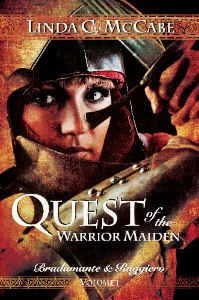
Once again I am running this competition for all those who haven’t won. You have a good chance of winning a free copy of my novel if you share this post on Twitter and Facebook please, with all your followers. Please comment below when you have done that to enter.
I truly appreciate all your support. I intend to give away almost every copy I got from my publisher, thirty in total. I will keep one for myself. So you do have a good chance of winning if you keep coming back and sharing.
If you are a writer and want to be on my list for guest posts please email me: lob@yourasms.com and I will send you guidelines. I want us all to work together to promote our writing.





 Robin of Rockridge's Blog